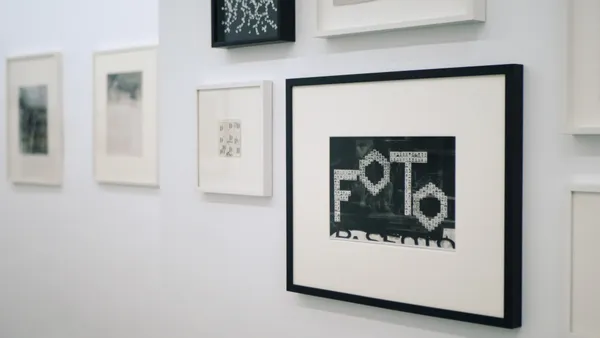
Sophie Calle Française, b. 1953
Born in Paris in 1953, Sophie Calle has been developing a distinctive body of work since the late 1970s, situated at the intersection of photography, writing, performance, and installation. She grew up in a family with a strong interest in contemporary art: her father, a physician and collector, was the founder and first director of the Carré d’art in Nîmes. This background introduced her at an early age to emerging practices on the French art scene.
After a period of travel and political engagement in the 1970s, she began a series of artistic experiments based on simple protocols, often inspired by lived situations, that dissolve the boundary between art and everyday life. From her earliest works, Sophie Calle adopted the role of an investigator or detective, accumulating clues, traces, photographs, and narratives.
Whether inviting strangers to sleep in her bed (Les Dormeurs, 1979), following anonymous passers-by (Suite Vénitienne, 1980), or intruding into the lives of others, her work explores absence, disappearance, desire, and memory. Writing plays a central role: neither illustrative commentary nor a simple caption, it functions as an autonomous narrative device, closely intertwined with the photographic image.
Blending fiction and autobiography with a sense of detachment often tinged with humour, her work gives a pivotal role to the viewer, who is invited to become a witness, and sometimes a voyeur, to intimate narratives.
Since the 1980s, Sophie Calle has exhibited regularly at major international institutions. She represented France at the Venice Biennale in 2007 and received the Hasselblad Award in 2010.
-
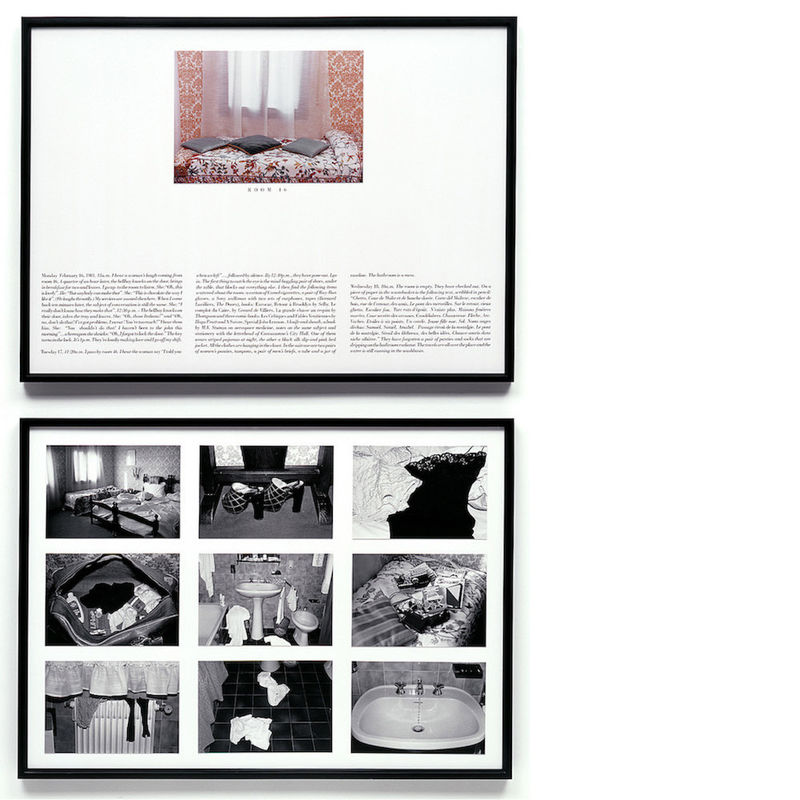
 L'Hôtel, Chambre 46, 16 février 1981, 1983View more details